Author, Trina Ayling, created this fun free word scramble for kids! Please click link to go to the larger printable PDF version > ACTIVITY PAGES

Author, Trina Ayling, created this fun free word scramble for kids! Please click link to go to the larger printable PDF version > ACTIVITY PAGES
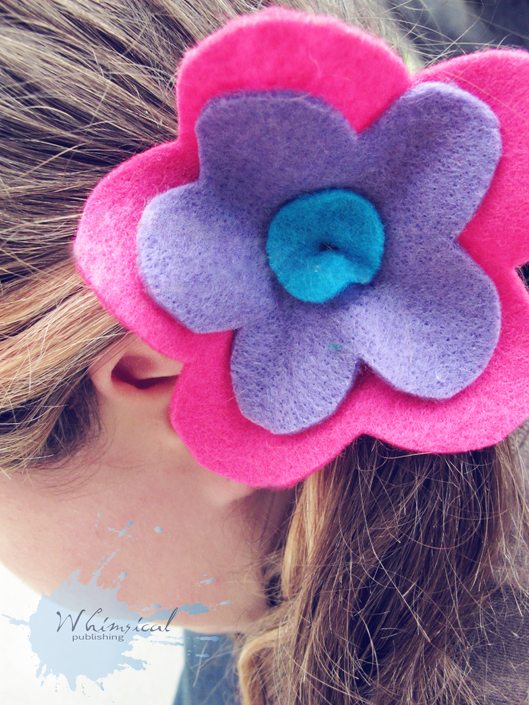
This is a super easy craft to make with your kids – it’s also an especially nice way to use up scrap felt or even other scrap fabrics!

What you need;
– scissors
– needle & thread
– paper
– hair elastics
– felt fabric in various colors
– Flower Template<<<please click here to download free flower template.

First cut out paper flower template and use this as a guide to cut felt flowers and flower centers.


Arrange flowers as shown above and sew through all three layers into the hair elastic – as shown below >>>


It’s as simple as that! I hope you enjoy!!!
Please check out out other FREE crafts, coloring pages & activities for kids >>> CRAFTS – COLORING PAGES – ACTIVITY PAGES
~Micheline
 When I was six I lived a couple of blocks from St. Mary’s church. Both grand and inviting this beautiful circular structure was created by aboriginal architect Douglas Cardinal. My sister, friends and I loved to play hide and seek among the confessionals and pews. But we especially liked the mice that lived in the fields around the church.
One crisp October evening we got it into our heads that it was too cold for the mice to sleep safely outside. So we gathered up a dozen of them with the idea of providing warmer beds within the church.
I don’t know where we got the idea that mice couldn’t survive outside, but I have a feeling it had a lot to do with the stories we read as kids. From “The Night Before Christmas” to “The Country Mouse and the City Mouse” these critters seemed to be a lot like us humans. Thankfully, the kind priest helped us understand why mice must live outside.
Even though I no longer view mice through the humanizing eyes of a child I still love the children’s stories that do. I guess that’s why –even though Miss Emily Goes to Bat is the story about a cat –you’ll find mice on every page.
You can have a look at this amazing church at http://stmarysparish.shawwebspace.ca/photos/view/our_church/. The field is gone and the rose garden is new, but the building remains a work of art.
~Trina
 Last Christmas I donated all of my Dr. Seuss books to “A Book Under Every Tree.” It’s a wonderful literacy initiative that benefits kids who may not have a lot of books in their home. I was happy to donate the books but the fact is I kinda miss them as well.
You see Dr. Seuss is one of my favourite authors and even though Will and Thom think they’ve outgrown his stories, I know I haven’t. Perhaps it’s his use of nonsensical words or the enjoyable way they roll off my tongue. Perhaps it’s the unstated yet resonant message of his stories. Or perhaps it’s my appreciation for the man himself.
Dr. Seuss (born Theodor Seuss Geisel) had moxie. Despite the fact that he came from a family of German brewmasters during the onset of prohibition and World War I, Seuss (aka Ted) was able to gain popularity with his peers simply by being himself.
Seuss had perseverance –his first children’s book, And to Think That I Saw It on Mulberry Street, was rejected 27 times before going to publication.
He had talent and versatility. Before he was a best-selling author he was a cartoonist for such notable publications as The Saturday Evening Post, Life and Vanity Fair. He was an ad man, a patriot and an academy award winning animator of World War II military training films.
And he changed the way educators approach children’s literacy.
Not everyone is aware of this, but Dr. Seuss’ Cat in the Hat –considered to be the first “playground word-of-mouth bestseller” –was actually written in response to a challenge from William Spaulding, then-director of the education division at Houghton Miffin.
Spaulding had read a 1954 Life magazine article by John Hersey that suggested the reason schoolchildren couldn’t read was because books, like Dick and Jane, “were too boring”. (True that!) Spaulding then challenged Seuss to not only write a story that 1st graders wouldn’t be able to put down, but to write it using no more than 250 of the 348 words that Spaulding felt were important for grade one children to know. Seuss used 236.
I guess that’s the secret to Seuss and why he’s a favourite of mine –moxie, perseverance, talent and legacy. Yes, I admit I still miss my Dr. Seuss books but when I consider the benefits they’re providing to their newest owners I think I can live without them. 🙂
~ Trina
Being a part of our newsletter family keeps you up-to-date on all things Whimsical, and gives you access to exclusive inside perks like: GIVEAWAYS, ARCs, PROMOS, SALES, STREET TEAMS, GIFTS, and more.